Rework and Refire Process in Sanitaryware Manufacturing
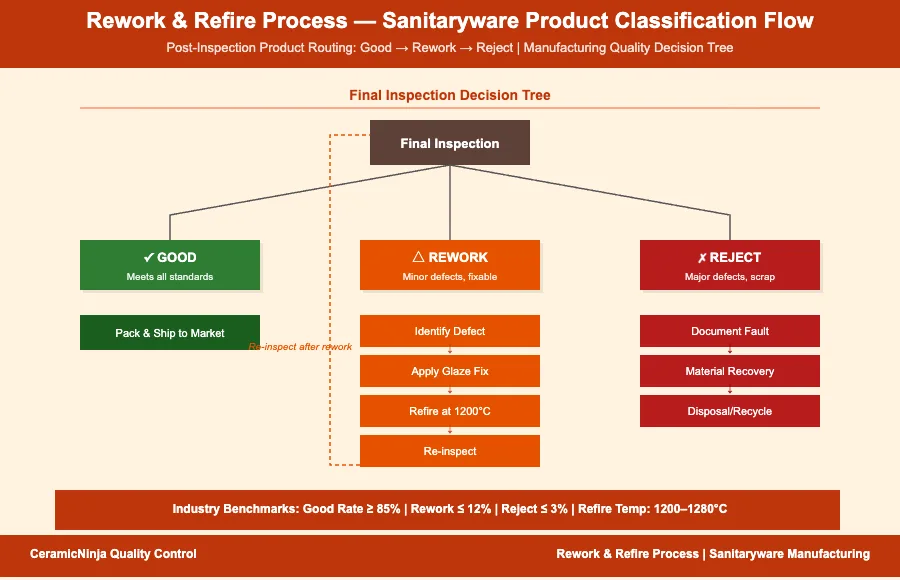
In the sanitaryware manufacturing process, products are categorized after the final inspection into three main groups:
Rework and Refire Process in Sanitaryware Manufacturing
After final inspection in a sanitaryware factory, every product is placed into one of three categories. Understanding these categories helps the factory team take the right action for each piece.
Product Categories After Final Inspection
- Good — Product meets all quality standards. Ready for packing and dispatch.
- Rework — Product has minor defects that can be repaired and refired.
- Reject — Product has major defects and cannot be repaired. It is scrapped.
Note: Some factories do not use these three category names. Instead, they grade products as Grade 1, Grade 2, or Grade 3.
What Are Rework Pieces?
Rework pieces are products with small defects that can be corrected. These defects include:
- Small cracks
- Pinholes
- Black specks
- Crawling (glaze pulling away from the surface)
- Logo defects
- Bat wash marks
- Clay bits on the surface
- Other minor imperfections
If a product has more than one minor defect, all defects are repaired in a single rework cycle. This saves time and reduces the number of times the product needs to be handled.
Steps in the Rework and Refire Process
1. Grinding the Defect Area
The defective area is scratched or ground using a diamond-coated grinding burr. This removes the surface imperfection and prepares the area for repair.
2. Dust Removal
After grinding, all dust and debris from the defect area must be cleaned completely. Any remaining dust can cause new defects after refiring.
3. Glaze Application
New glaze is applied to the repaired area. The glaze must match the original colour and texture of the product. Proper glaze application is important to ensure the repair is not visible after firing.
4. Refiring
The product is placed back in the kiln and fired again. Refiring requires better airflow than the first firing. This is important to get a good yield and to maintain uniform temperature throughout the kiln.
Quality Check After Refiring
Once refired, the product goes through inspection again to check if the defects have been corrected. A product can be refired a maximum of three times. Refiring more than three times can weaken the product and affect its quality.
The rework and refire process helps the factory reduce waste, improve production efficiency, and maintain quality standards without rejecting too many pieces unnecessarily.
Share this article
Previous
Quality Assurance in Sanitaryware Product Manufacturing
Next
Chipping and Glaze Knock Defect in Ceramics Manufacturing
Written by
CeramicNinja
Ceramic industry professional & content contributor.
Leave a Comment
Add your comment
No comments yet. Be the first to share your thoughts!
Keep exploring
Hand-picked across articles, marketplace and jobs
 Article
40 Important Laboratory Tests in Sanitaryware Manufacturing
Various tests are being carried out by the laboratory in a sanitary ware production process to ensure the Quality of the Final product. And testing starts from raw material discharge area up to Dispatch. This test are very important to keep the rejec
Read article Marketplace