Quality Assurance in Sanitaryware Product Manufacturing
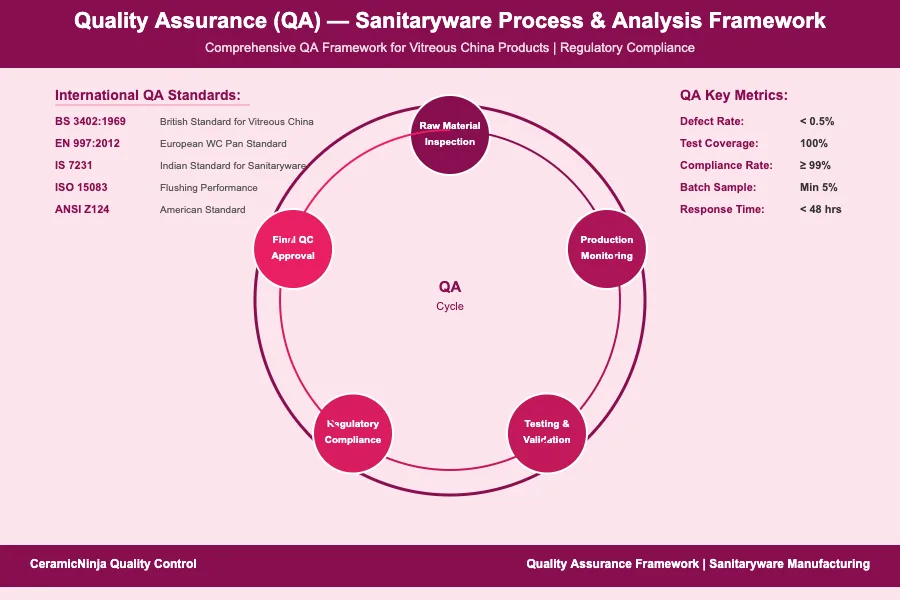
The Quality Assurance (QA) team is essential in ensuring the efficiency, reliability, and quality of sanitaryware products. Their primary responsibility is to confirm that the products meet the company's internal standards as well as the regulatory requirements of the countrie...
Quality Assurance in Sanitaryware Product Manufacturing
The Quality Assurance (QA) team plays a very important role in a sanitaryware factory. Their job is to make sure that every finished product meets the company's quality standards and also meets the rules set by different countries where the product is sold.
Country-Specific Standards
Different countries have their own standards for sanitaryware testing. The QA team uses these standards to check if the final product is acceptable. Here are the main standards used:
BS 3402:1969 — British Standard for vitreous china (UK)
IS 2556 — Indian Standard
SNI 03-0797-2006 — Indonesian Standard
AS 1172 — Australian Standard
SS 574:2012 — Singapore Standard
Final Product Testing
The QA team checks the final product through several important tests. These tests are done after the product is fully made and ready for inspection.
Dimensional Testing
This test checks whether the product matches the correct design measurements. Key dimensions like closet height, outer diameter, water seal depth, and mounting seat hole sizes are verified. If the dimensions are wrong, the product will not work properly or fit correctly.
Flush Testing
Flush testing checks how well the toilet flushes waste. This includes several specific tests:
Toilet paper flush test
Smudge test
Single ball and fifty ball test
Sawdust flush test
Splash test
Flatness Testing
The upper and lower surfaces of the product are checked for flatness. The surface must be within acceptable limits. If not, the product is rejected or corrected depending on which surface has the issue.
Leak Testing
Water leakage and air leakage tests are done to confirm the product has no cracks or gaps. Zero leakage is required. If even one drop of water is found, the product is rejected.
Load Testing
This test checks if the product can handle normal use weight without breaking or cracking. The product must pass the required load without any damage.
Visual Inspection and Audit
After all the physical tests, the QA team also does a detailed visual inspection. They check for surface defects like cracks, chips, colour issues, or glaze problems. This final audit makes sure no defective product is passed to the customer.
The QA team also gives regular feedback to the production and quality control teams to keep standards consistent across all batches.
Customer Complaint Handling
If a customer reports a problem with a product, the QA team investigates the root cause. They review the production process and test records to find where the issue happened. This helps prevent the same problem from happening again in future batches.
Continuous Improvement
By running proper tests, fixing issues early, and learning from complaints, the QA team helps the factory keep improving. The goal is to make sure every sanitaryware product that leaves the factory is reliable, safe, and meets all required standards.
Share this article
Previous
Water Seal Test for Sanitaryware Product: Method & Analysis
Next
Rework and Refire Process in Sanitaryware Manufacturing
Written by
CeramicNinja
Ceramic industry professional & content contributor.
Leave a Comment
Add your comment
No comments yet. Be the first to share your thoughts!
Keep exploring
Hand-picked across articles, marketplace and jobs
 Article
40 Important Laboratory Tests in Sanitaryware Manufacturing
Various tests are being carried out by the laboratory in a sanitary ware production process to ensure the Quality of the Final product. And testing starts from raw material discharge area up to Dispatch. This test are very important to keep the rejec
Read article Marketplace